
Fitness Friends, it has been awhile since I’ve done a good solid form breakdown post. I mean a while. Like almost two years. So I am resurrecting this series and I thought I’d start with a seems simple enough exercise that most of us do on the regular: push ups.
Push ups are classic strength training fare for a reason. They straight up work. You want to work muscle endurance, drop and give me 50. You want to work muscle strength, add in pauses. You want to work on explosive power, throw in a clap. And you’ll hit just about every muscle on the front side of your body doing it.
Push ups can be torturous, though. It is the push exercise, meaning the main muscle movers are your pec major and minor. But don’t be fooled, front deltoids and triceps have a pretty big role too. Stabilizing the shoulder joint and bending the elbow under the full weight of the body is nothing to sneeze at. These muscles usually mean that the joints in question are wrists, elbows, and shoulders. Two of which tend to give a lot of people some sort of trouble.
Which is the basis of the problem. Shoulder and wrist comfort should be the drivers of body position, not ego and certainly not influencers who can’t spell biomechanics with an AI assist. But I’ll get to this in a minute.
A good quality push up is a base exercise that most should be able to accomplish and have in the exercise arsenal. Here’s the kicker, it doesn’t have to be the traditional from your toes on the ground style push up to count. And it certainly doesn’t have to be the traditional format for it to work well for you. All that being said, here are my top tips for a perfect (for you) push up.
First and foremost, do a bit of shoulder prep. Even if you don’t have shoulder issues. In fact, especially then, we’d like to keep it that way as long as possible. It doesn’t have to be involved; a few arm circles both forward and backwards will probably do it. You really want to focus on these, though. Take your time and make sure momentum isn’t taking over. Additionally, pay special attention to how your shoulders feel. Any tightness or pulling? Hitches in motion? Does either shoulder feel (and/or sound) like a packet of Pop Rocks dumped into a bowl of Rice Krispies? And again, note where in the motion.
Second, practice the breath with the arm motion without weight. Flex and extend your elbows out in front of you. Inhale as you bend your elbows in, and exhale as you push them back out. Yes, you will look ridiculous, but you’ll thank me when your breath comes much more naturally during your first few reps. That exhale on the push is everything.
Third, if you have never taken the time to mess around with hand placement, do it. Wrists can be tricky and there are too many trainers out there that insist your fingers point directly forward. Honestly, much like your foot placement in squats, as long as you aren’t changing the angle of your fingers by more than 10 degrees or so, it makes no difference except in terms of comfort.
And on that note, if you can’t find a comfortable spot for your wrists with your palms completely flat, guess what? You don’t have to force that position either. Push up bars or hex dumbbells as grips are game changers. Working out at home or your gym doesn’t have push up bars? Get a towel for some cushion, then make fists. Place your fists down flat on the towel so your wrist stays completely in line with your palm.

Still not comfy? I get it, it’s a lot of pressure to put on a relatively small and fragile joint. This is where propping on a sturdy chair, table, bench, or wall can make a big difference. There is no shame in that. Better to protect your joints during the exercise and be able to complete it than risk injury.
Which moves us on to shoulders. The most common reason people have shoulder discomfort during push ups is because they are set up incorrectly. Story of my life. Our instinct is to set up with our hands wide and in front of our shoulders. But from a biomechanical perspective, this actual sets our shoulders up for struggle and pain. This puts the angle of force through the top of the shoulder rather than through the body of the joint where the muscles can better handle the stress.
So bring your hands in an inch or so and set them up behind your shoulders just a hair. You’ll know you’re in the right place by watching your elbows during your reps. If they are flaring out directly to the sides, you are too far in front of your shoulders. If your elbows stay tucked by your ribs more easily, you’re good. Of course, any discomfort means the position doesn’t work for your body. So find that chair, table, bench, or wall.
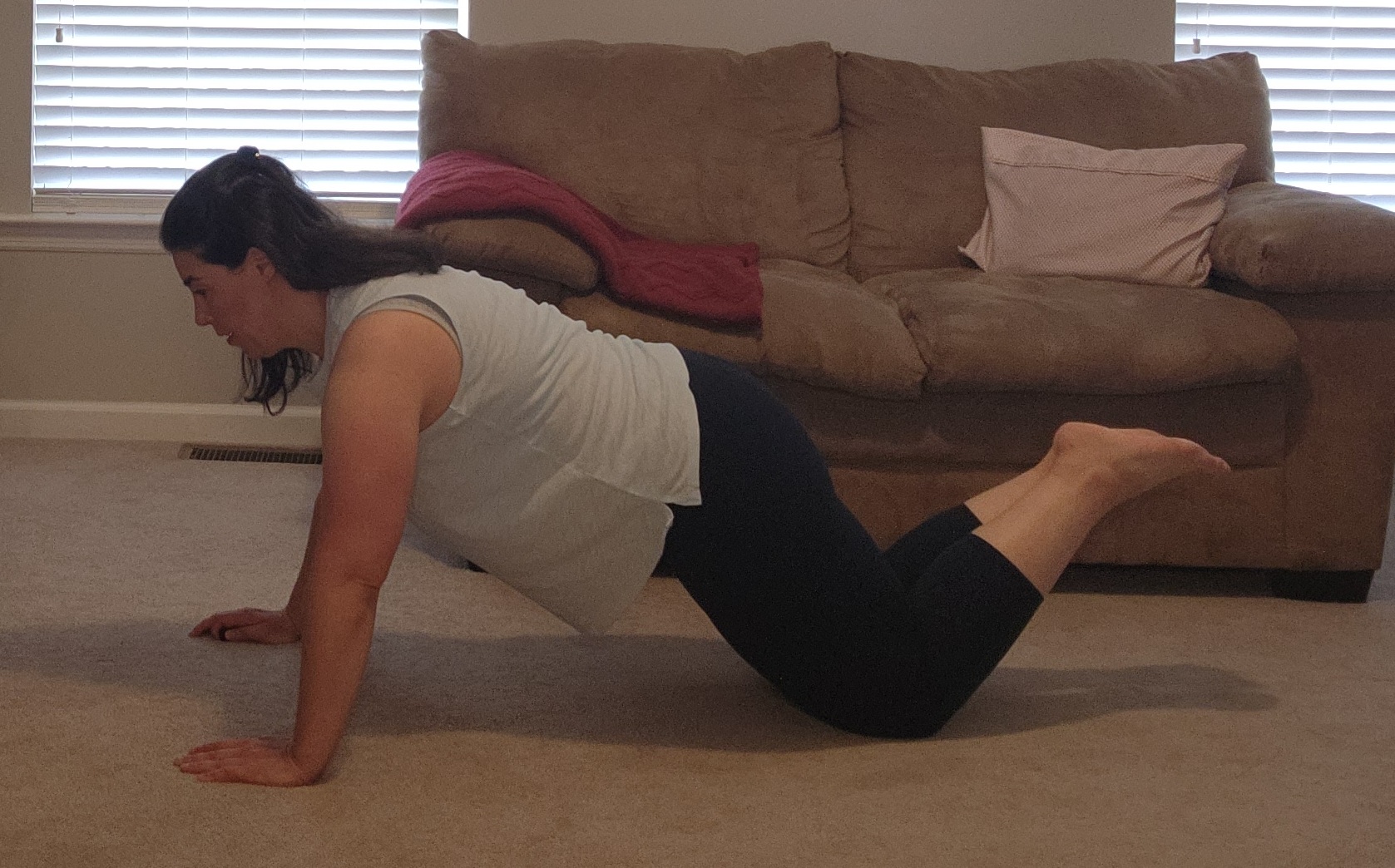
As an example, you can see the difference in my elbows in the pictures below. In the toes down position my elbows are flaring out too far and my head is leading showing that I am struggling to balance forces at my shoulder. With my knees down, my head is aligned with my spine and my elbows are tucked back a bit.

Which brings me to my last tip, and probably the most important one: Let go of your ego. No exercise, no matter how basic it seems, is worth injuring yourself over. A proper push up is one where the force can be balanced at the shoulder without strain or pain. A proper push is one where the wrists are able to carry the load without discomfort. As a trainer, I’d much rather see people tweak what they need and reap the benefits of this great exercise.
Until next time, be well friends!
0