
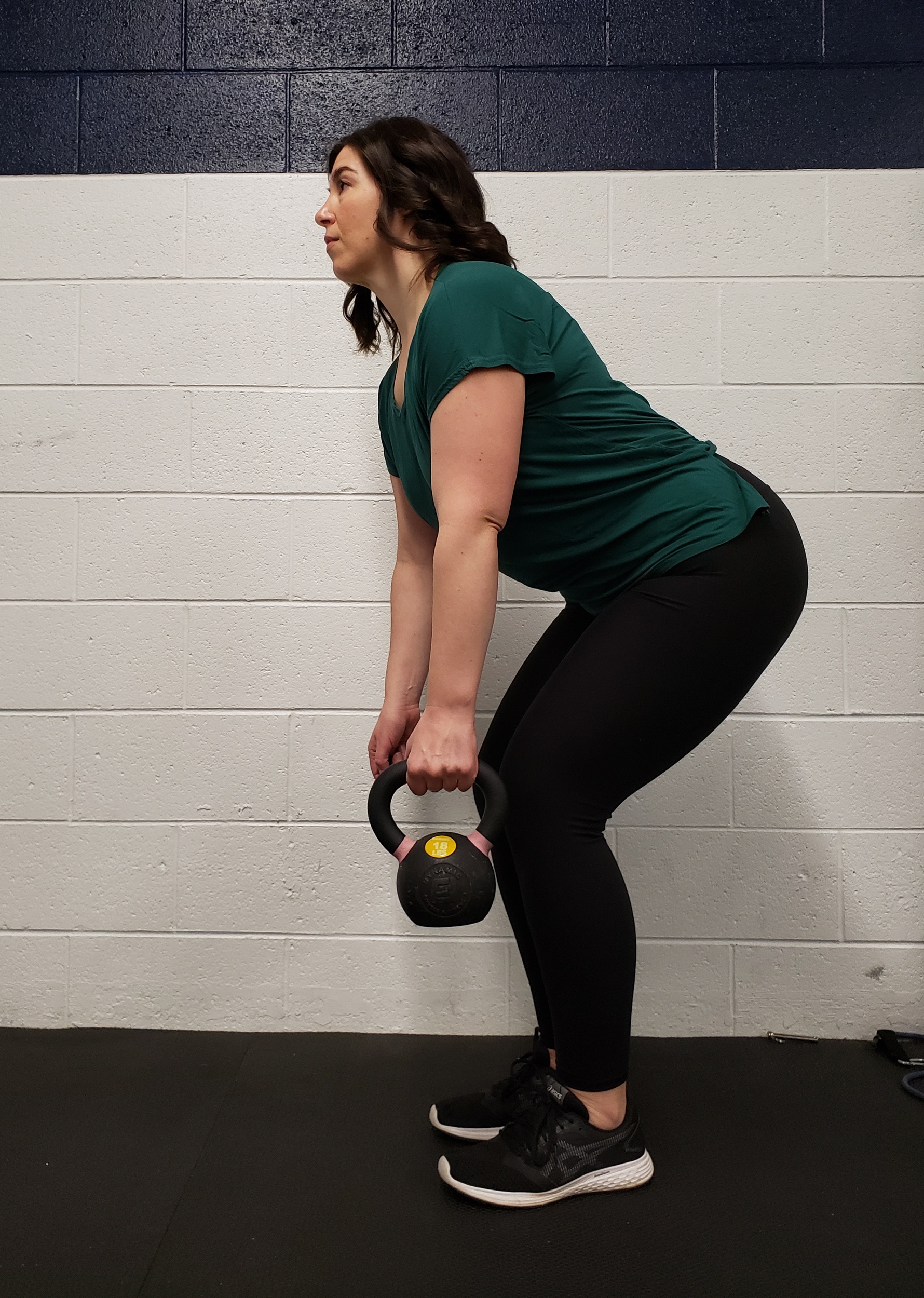
Happy February Friends! I hope wherever you are, things are looking positive. For me, it doesn’t matter what the Groundhog says, it’s six more weeks of winter minimum. But while it might be freezing outside, I am probably keeping warm with some sort of strength routine. And I can’t think of a better exercise to work a ton of muscle groups than deadlifts.
Deadlifts are one of those strength exercises you either love or hate. Love to hate. Possibly hate to love. Long story short, they inspire strong feelings. And it makes sense why. It’s a complex movement that involves coordinating a lot of large muscle groups. However, it is because of this complexity that deadlifts are so important.
Deadlifts involve every lower body muscle group (quads, hamstrings, and glutes) plus a good amount of the deep muscles in the lower back and core. Now, you can make the argument that squats hit these same muscle groups. And I’d agree with you, although the low back and core involvement is to a slightly smaller degree. But, to me, the biggest difference between squats and deadlifts is the amount of control needed.
See, with squats you should be controlling everything through the entire motion. There isn’t a personal trainer alive that will tell you otherwise. But, if you cheat a bit and let gravity give you the assist on the downward phase during squats, it’s not the end of the world. With deadlifts, though, you need to be locked in control wise for the entire range of motion otherwise you aren’t going to get everything out of the exercise that you otherwise could.
Typically, in these form tips and tricks posts, I start off by talking about setting up properly and how that’s the basis for good form. I haven’t body swapped, so be patient, I’ll get to that. My first tip for deadlifts, though, is to rehearse them without weight. Even if you aren’t pushing 90% of your one rep max, the coordination necessary for deadlifts requires a bit of a prep. In fact, deadlifts are the one and only strength exercise that I complete an unweighted practice set for. Every. Single. Time.
This practice set is all about getting the timing right and fostering that mind-muscle connection that makes the coordination smoother. So, set your feet where you like. Get your shoulders, elbows, and wrists in position assuming you are holding weights. Take two to three slow, even, and steady breaths while you contract your core and lower your torso to the start position. Make sure you are exhaling to stand up, inhaling to lower down and complete one full set. Take the time to double check your breath and do a body scan. Make mental notes of any muscle pain, joint stiffness, or range of motion hitches.
My second tip is to repeat the practice process if you notice anything that feels off in your body. We all have weird gym sessions. Nothing overt seems out of place, but for whatever reason the body is just not cooperating on that particular day. If you noticed pain, joint immobility, or range of motion issues, take another practice round with your focus on the area that is giving you fits. If, after this second round, you are still having discomforts, tweak the deadlift. This can be as simple as taking a smaller range of motion to keep the body comfortable. This can be as involved as picking a different version of deadlifts to do. Deadlifts are not the exercise to go into on an ego takeover.
Now we are going to set up properly. I don’t mind the use of lifting belts or grips as an assist. You don’t want your grip to fail before your glutes and you don’t want to lose the core brace in the middle of a set. However, proper form always has to come first. Those accessories are just that. Your body should be doing the majority of the work.
Your feet should be about hip width apart with your toes pointing forward. A deadlift is a hinge motion, so your set up should mimic exactly that. A hinge forward at the hips with a slight bend in the knees. Your core should be engaged and your back flat. Move your shoulder blades down if you struggle with that. Before the weight even moves off the floor, you should inhale and take the slack out of your body. Hold that position through the exhale. Then lift on the next inhale.
The fourth tip I have has to do with the big equipment, read the barbell. I am about to say something that will probably tick off a lot of lifters, but here goes. I hate standard barbell deadlifts. I hate performing them for myself. I hate coaching them. (See, I have strong feelings, too.) And the only times I program them for clients is if someone is interested in lifting competitively. You may ask, but Melissa, these are the “gold standard” why do you dislike them so much? Because the potential injury cost of doing standard barbell deadlifts is way too high for the majority of people.
Most gyms have a hex or trap bar. Basically this barbell has the ends that can be loaded as typical, but the middle is a giant hexagon that you stand inside of. The shape of this barbell alleviates shoulder issues and pain. It helps keep the torso upright. It takes the strain off wrists and elbows. And it distributes the weight more evenly over the lower body which reduces load on the lumbar spine. So, in short, go find a hex bar for deadlifts. And if you feel like you aren’t ready for that, here is a pretty thorough breakdown of different deadlift variations.
My last tip with deadlifts relates to that ego I mentioned earlier. Leave it at the door. More than any other exercise (except maybe Olympic lifts like clean and jerks), there is too much at stake in the body to be messing around. I’ve seen too many people slip a disc, rupture a biceps tendon, or just straight up pass out because they decided weight over anything else and did so with terrible form. Don’t be that person. Don’t make us call 911. It’s not cool.
Hope these tips are helpful and until next time, move well friends!
0